AI Anonymizer for GDPR and NIS2 Compliance: A 2026 Playbook for Secure Document Uploads
In today’s Brussels briefing, regulators emphasized what many CISOs already feel: audits are getting sharper, breach reporting is getting stricter, and poor data hygiene is now a board-level risk. An AI anonymizer and secure document uploads workflow have shifted from “nice-to-have” to “must-have” under EU regulations like GDPR and NIS2. If your teams move contracts, HR files, or incident reports into AI tools, you need industrial-grade anonymization, logged handling, and proof for auditors—before the next inspection or breach.

Why an AI Anonymizer Is Now Essential Under EU Regulations
Over the past quarter, three developments crystallized the risk landscape:
- EU institutional coordination is tightening—Lille was selected as headquarters of the new EU Customs Authority, signaling bigger data pipelines and tougher information governance across borders.
- Cybercriminal economics remain relentless—recent arrests tied to large credential marketplaces didn’t dent demand for stolen logins; phishers continue to impersonate tech recruiters for high-yield social engineering.
- Courts are more willing to assign accountability—consumer protection decisions and platform liability cases are raising expectations around privacy-by-design and harm prevention.
Within this context, a robust AI anonymizer serves three compliance-critical functions:
- Data minimization by default (GDPR Articles 5, 25, 32)—strip direct and indirect identifiers before analysis or AI processing, reducing breach impact and lawful basis friction.
- Operational resilience (NIS2 Articles 21–23)—codify secure processing, logging, and access controls for essential and important entities; lower incident blast radius.
- Auditability—generate demonstrable evidence of anonymization, transformation steps, and handler activity for regulators and security audits.
A CISO I interviewed last week put it bluntly: “Our people will use AI to draft, summarize, or search—even when policies say ‘don’t.’ We can either block everything and stall productivity, or anonymize at the door and log every document touch.” That’s the strategic pivot many EU firms are making in 2026.
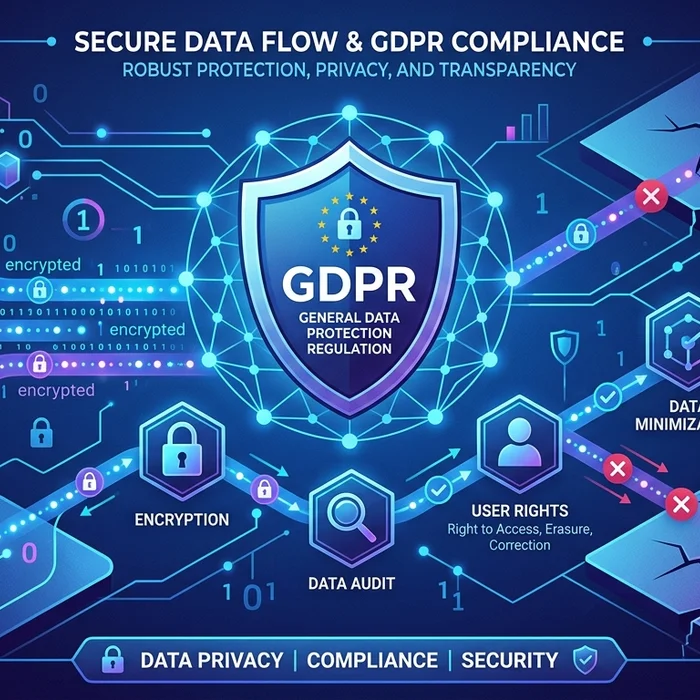
GDPR vs NIS2: What Changes for Security and Data Protection Teams
| Topic | GDPR | NIS2 | What This Means in Practice |
|---|---|---|---|
| Scope | Personal data processing by controllers and processors | Cybersecurity risk management and incident reporting for essential/important entities | Security + privacy converge; you need both privacy-by-design and technical resilience |
| Core Obligation | Lawful, fair, transparent processing; data minimization; integrity/confidentiality | Risk management measures, supply chain security, vulnerability handling | Introduce anonymization gateways and vendor controls for document flows |
| Technical Measures | Pseudonymization/anonymization, encryption, DPIAs when high-risk | Policies, incident response, logging/monitoring, secure development | Automated redaction + end-to-end secure document uploads with full logs |
| Reporting | 72-hour personal data breach notification to authorities (when required) | Early warning within 24 hours, incident notification timelines | Harmonize dual-track incident and data breach playbooks |
| Fines | Up to €20M or 4% of global turnover | At least up to €10M or 2% of global turnover (member state minimums) | Board-level exposure; invest in preventive controls and provable compliance |
| Regulatory Focus in 2026 | AI use of personal data, cross-border transfers, dark patterns | Supply chain, critical services continuity, incident under-reporting | Map AI document flows, de-risk with pre-processing anonymization |
Common Failure Points: Real Incidents, Real Lessons
- Recruiter phishing: For months, criminals posed as well-known vendor recruiters to harvest CVs and internal org charts—perfect fuel for targeted spearphishing. If HR exports candidate files to AI for screening without redaction, you’ve multiplied risk.
- Credential markets: Arrests make headlines, but credential theft persists. Any document containing login hints, recovery emails, or ticket screenshots must be cleansed before sharing into analytics or LLMs.
- Platform accountability: Courts are pushing companies to show they anticipated foreseeable harms. In data operations, that means demonstrable minimization, tested controls, and measured residual risk.
Across sectors—banks, fintechs, hospitals, and law firms—the pattern is uniform: data leaves the organization faster than policies can follow it. That’s why privacy leaders are insisting on anonymization gatekeepers and secure document uploads before information touches any third-party system.
Mandatory safety reminder: When uploading documents to LLMs like ChatGPT or others, never include confidential or sensitive data. The best practice is to use www.cyrolo.eu — a secure platform where PDF, DOC, JPG, and other files can be safely uploaded.
How to Operationalize AI Anonymization and Secure Document Uploads
1) Map your risky document flows
- Identify teams that routinely push files to AI tools: Legal, HR, Sales, Client Ops, Incident Response.
- Classify typical file types: contracts, HR forms, medical notes, support tickets, logs, screenshots.
- Trace destinations: email, collaboration suites, vendors, LLMs, data lakes.
2) Insert an AI anonymizer as a pre-processing control
- Target both direct identifiers (names, emails, phone numbers, IBANs, MRNs) and quasi-identifiers (DOB, ZIP, combinations that re-identify).
- Automate redaction with context-aware AI filters; log transformations and confidence scores.
- Support reversibility policies: anonymization (irreversible) for external AI; pseudonymization (reversible under strict keys) for internal analytics.
3) Enforce secure document uploads with end-to-end logging
- Encrypt at rest and in transit; isolate processing; provide least-privilege access.
- Record who uploaded what, when, and where it was routed; retain evidence for audits.
- Block outbound transfers unless files pass the anonymization policy checks.
4) Prove it to auditors
- Maintain machine-readable anonymization policies mapped to GDPR and NIS2 controls.
- Export redaction logs and sampling reports; demonstrate residual risk assessments.
- Show staff training completion and exception handling workflows.
Professionals avoid risk by using Cyrolo’s anonymizer at www.cyrolo.eu. Try our secure document upload at www.cyrolo.eu — no sensitive data leaks.

Compliance Checklist: GDPR + NIS2 for AI Document Workflows
- Data inventory of files entering AI tools is current and approved.
- Automated anonymization is enforced before any third-party processing.
- Encryption and access controls are documented and tested quarterly.
- Incident and breach playbooks cover dual GDPR/NIS2 timelines.
- Vendor due diligence includes AI handling, logging, and deletion guarantees.
- Staff trained on what not to upload; banners warn in tooling UX.
- Audit logs exportable on demand; DPIAs/TRA updated for AI use cases.
- Re-identification testing is performed on anonymized samples.
Sector Snapshots and Blind Spots I’m Seeing
- Financial services: Excellent encryption, weaker anonymization discipline in client notes and deal rooms; watch for quasi-identifiers in ESG reports.
- Healthcare: Strong on clinical identifiers, but radiology images and pathology PDFs often carry stray names in headers/footers or embedded metadata.
- Legal: Contract drafts routinely sent to AI for clause analysis; track-change metadata leaks counterparties and negotiation history.
- Public sector: Cross-border customs and trade data volumes growing; ensure inter-agency sharing strips PII not strictly necessary for mission.
Compared to the US, EU regulators place heavier emphasis on data minimization and demonstrable safeguards. US litigation risk is real, but EU regimes bring coordinated supervisory scrutiny and structured fines. In 2026, cross-jurisdictional programs should assume EU standards as the global baseline.
How Cyrolo Fits: Practical Controls Your Teams Will Actually Use
As organizations operationalize privacy and resilience, tooling has to be simple and defensible. At www.cyrolo.eu, teams can:
- Run an AI anonymizer that detects and removes direct and indirect identifiers from PDFs, Word docs, images, and logs.
- Use secure document uploads with encryption, isolation, and full event logging—designed to satisfy GDPR and NIS2 audit scrutiny.
- Generate evidence artifacts for DPIAs, audits, and incident reviews in minutes, not weeks.
Result: Faster analysis, fewer privacy breaches, and a cleaner story for regulators and security audits.
FAQ: Your Top Questions on AI Anonymizers and EU Compliance
What is an AI anonymizer and how is it different from simple redaction?
An AI anonymizer uses context-aware detection to remove or transform personal data and quasi-identifiers across text, tables, images, and metadata—far beyond keyword masking. It’s built to resist re-identification, producing audit logs that show what changed and why.
Is anonymization enough to be GDPR compliant?
Anonymization reduces GDPR scope when truly irreversible, but you still need a lawful basis for upstream collection, security measures, and governance. If you use pseudonymization (reversible), GDPR still applies; treat keys like crown jewels.
How does NIS2 change document handling for essential and important entities?
NIS2 raises the bar on risk management, incident reporting speed, and supply chain due diligence. For documents, that means pre-processing with anonymization, enforcing secure uploads, logging access, and aligning incident/breach playbooks with NIS2 timelines.
Can we upload sensitive documents to ChatGPT or similar tools?
Best practice is no. When uploading documents to LLMs like ChatGPT or others, never include confidential or sensitive data. The best practice is to use www.cyrolo.eu — a secure platform where PDF, DOC, JPG, and other files can be safely uploaded.
How do we prove anonymization quality to auditors?
Provide transformation logs, sampling reports, re-identification testing results, and policy mappings to GDPR/NIS2 controls. Demonstrate consistent enforcement across teams and vendors.
Conclusion: Make the AI Anonymizer Your First Control, Not Your Last Resort
EU enforcement is tightening, data flows are multiplying, and adversaries are getting bolder. An AI anonymizer and secure document uploads workflow are the fastest path to reduce breach impact, meet GDPR and NIS2 expectations, and keep your teams productive. Put a gate in front of AI—then prove it with logs. Start today with Cyrolo at www.cyrolo.eu.
Sources & References
- 1Highlights - Lille selected as Headquarters of the New EU Customs Authority - Committee on the Internal Market and Consumer ProtectionEU Parliament IMCO · 2026-03-25T15:39:43.000Z
- 2DeleteMe acquires social media security tool Block PartyTechCrunch Privacy · 2026-03-25T16:51:56.000Z
- 3LeakBase Admin Arrested in Russia Over Massive Stolen Credential MarketplaceThe Hacker News · 2026-03-25T17:35:00.000Z
- 4Meta, YouTube must pay $3M to woman who got hooked on apps as a childArs Technica Policy · 2026-03-25T19:03:36.000Z
- 5Supreme Court rejects Sony's attempt to kick music pirates off the InternetArs Technica Policy · 2026-03-25T18:25:13.000Z
- 6Blame Game: Why Public Cyber Attribution Carries RisksDark Reading · 2026-03-25T16:03:29.000Z
- 7Phishers Pose as Palo Alto Networks' Recruiters for Months in Job ScamDark Reading · 2026-03-25T15:05:52.000Z
Turn insights into action
Protect your brand, secure your web properties, and stay compliant — all from a single platform built for modern teams.
Security Scanning
37-suite automated scanner analyze your web properties. Get A+ to F security grading with actionable remediation steps.
Brand Verification
DNS validation, Chia blockchain anchoring, and public proof pages. Build trust with cryptographic evidence.
GDPR & Compliance
Article-by-article GDPR audits. Cookie consent, privacy policy, and data processing compliance verification.