NIS2 compliance checklist: pass EU cybersecurity audits in 2025 without leaking data
In today’s Brussels briefing, regulators stressed that 2025 is the first full year of active supervision under NIS2—and boards will be judged on whether their controls work in practice. This NIS2 compliance checklist is my field-tested guide to help European organisations reduce breach risk, align with GDPR, and survive audits. If you’re sharing files with AI or vendors, safeguard personal data with anonymization and use a secure document upload workflow to prevent privacy breaches and fines.

- Primary risks: supply-chain malware, AI data leaks, weak incident reporting processes.
- Primary consequences: NIS2 fines up to €10M/2% for essential entities, GDPR fines up to €20M/4%.
- Primary fix: harden governance, prove risk management, and redact sensitive data before any external or AI sharing.
Why 2025 is different: enforcement heat and real-world threats
From my conversations with ENISA advisers and CISOs across finance and healthcare, the tone has shifted from “policy planning” to “evidence on the table.” National authorities are moving from guidance to inspections. The message is simple: show your controls, or show your chequebook.
Three trends are driving urgency:
- Active supervision under NIS2. Member States completed (or are completing) transposition, and audits are ramping up—especially for essential and important entities in finance, health, energy, digital infrastructure, public administration, and downstream suppliers.
- Supply-chain attacks are spiking. Recent developer-focused malware campaigns and package ecosystem compromises underline NIS2’s emphasis on third-party risk. A CISO I interviewed warned: “We passed a perimeter test, then failed a supplier tear-down. That’s where the regulators are looking this year.”
- Policy convergence. Alongside GDPR and sectoral regimes like DORA, NIS2 expects security by design, rapid reporting (early warning within 24 hours), and board accountability. Europe’s debate on secure multiparty computation and AI governance underscores that data handling is now a board-level security issue.
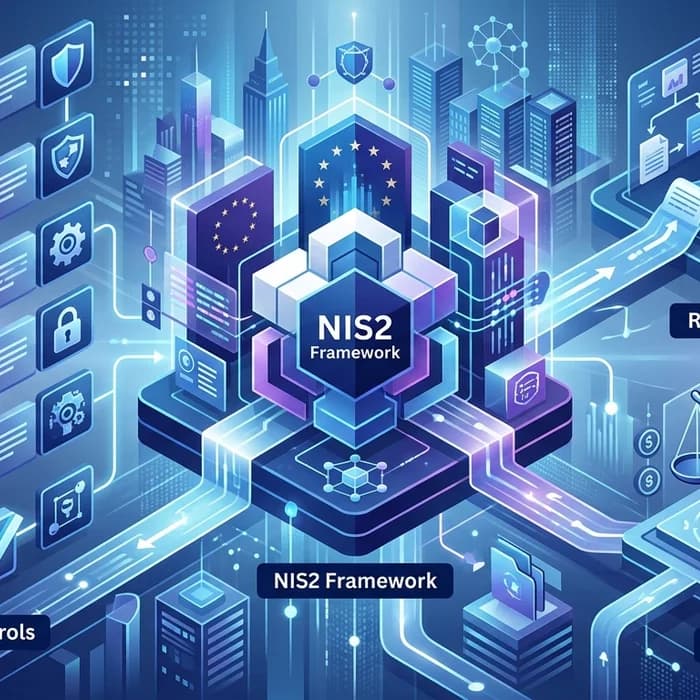
NIS2 compliance checklist: 14 controls auditors expect in 2025
Use this checklist to move from “policy on paper” to audit-ready practice.
- Board accountability documented — Name a responsible executive, record security briefings to the board, and minute risk decisions.
- Risk management methodology — Maintain a living risk register, mapped to critical services and assets; review at least quarterly.
- Asset and dependency inventory — Catalog business-critical systems, data flows, and external dependencies; identify single points of failure.
- Vulnerability and patch management — Define SLAs by severity (e.g., critical in 7 days), track exceptions, and evidence timely remediation.
- Secure software lifecycle — Apply code signing, dependency scanning, and IaC reviews; produce attestations for critical releases.
- Third-party risk management — Tier vendors, require security questionnaires and breach-notice clauses; collect evidence (e.g., pen test summaries).
- Incident response playbooks — Test at least annually; include decision trees for early-warning (24h), incident (72h), and final report (within one month).
- Business continuity and disaster recovery — Prove RPO/RTO alignment via restore tests; keep offline or immutable backups.
- Network and endpoint security — Enforce MFA, EDR, and least privilege; monitor east-west traffic; log and retain security telemetry.
- Data protection by design — Minimise personal data, and apply AI anonymizer workflows before sharing files with vendors or AI tools.
- Access governance — Quarterly access reviews for admin and privileged roles; JML (joiner-mover-leaver) automation.
- Security awareness and training — Role-based drills for SOC, DevOps, legal, and PR; phishing simulations tied to risk metrics.
- Metrics and KRIs — Track MTTR, patch SLA adherence, backup success, vendor assessment coverage, and incident trendlines.
- Audit trail and evidence pack — Centralise policies, change logs, incident tickets, vendor reviews, and board minutes for inspection.
GDPR vs NIS2 obligations: what your team must separate (and align)
GDPR and NIS2 overlap but do not duplicate each other. GDPR protects personal data across all sectors; NIS2 focuses on the resilience and security of essential and important services (and their supply chains). Many organisations must comply with both.
| Area | GDPR | NIS2 |
|---|---|---|
| Scope | Processing of personal data, any controller/processor | Cybersecurity of essential/important entities and critical services |
| Main Objective | Protect rights and freedoms of individuals | Ensure resilience, incident prevention, and service continuity |
| Governance | DPO for certain organisations; DPIAs | Board responsibility; risk management and technical/organisational measures |
| Incident Reporting | 72 hours to supervisory authority for personal data breaches | Early warning within 24 hours; incident notification within 72 hours; final report within one month |
| Supply Chain | Processor due diligence and contracts (Art. 28) | Explicit third-party risk management and dependency mapping |
| Sanctions | Up to €20M or 4% of global turnover | Up to €10M or 2% (essential) and €7M or 1.4% (important), depending on Member State implementation |
| Data Minimisation | Core principle (Art. 5) | Implied via security-by-design; reduce data exposure to lower impact |
How to handle documents safely: anonymization first, then controlled sharing
Most audit failures I’m seeing aren’t technical zero-days—they’re process gaps. Teams paste sensitive text into AI tools, email unredacted contracts to vendors, or upload medical PDFs to unmanaged clouds. That’s a breach waiting to happen under both GDPR and NIS2.
- Apply anonymization to remove direct identifiers (names, emails, IDs) and mask quasi-identifiers before sharing.
- Use a secure document upload workflow for PDFs, DOCs, and images, with clear retention/deletion policies.
- Log who uploaded what, when, and why—so you can reconstruct events in an audit.
- Prefer privacy-preserving analytics when possible; reduce the number of data processors touching your files.
Compliance note: When uploading documents to LLMs like ChatGPT or others, never include confidential or sensitive data. The best practice is to use www.cyrolo.eu — a secure platform where PDF, DOC, JPG, and other files can be safely uploaded.
Professionals avoid risk by using Cyrolo’s anonymizer to pre-process files, then sharing only what’s necessary. Try our secure document upload at www.cyrolo.eu — no sensitive data leaks.

Sector snapshots: what “good” looks like
- Banks and fintechs: Integrate NIS2 controls with DORA. Evidence that critical third parties meet patch SLAs; show tabletop exercises for payment outages. An EU bank CISO told me, “We ship an SBOM for core apps and require one from our vendors. It closes 80% of audit questions.”
- Hospitals: Segment clinical networks; test EHR recovery; maintain a whitelist for medical device updates. Redact patient data with an AI anonymizer before sending case files to external reviewers.
- Law firms: Classify client matter folders, enforce MFA on all devices, and route discovery uploads via a secure document upload workflow with documented retention and deletion.
- Software vendors: Embed SAST/DAST and dependency scanning; maintain release attestations; prove secure build pipelines and rapid revocation for compromised packages.
Build an audit-ready evidence pack
Auditors don’t want promises—they want proof. Assemble a single source of truth that includes:
- Board security briefings, approval of risk appetite, and training records.
- Risk register with owners, deadlines, and status changes.
- Patch dashboards and exception logs; vulnerability scan reports.
- Incident response drill reports, after-action reviews, and timing metrics (MTTD/MTTR).
- Vendor due diligence files, contracts with security clauses, and renewal reviews.
- Backups and restore test evidence; screenshots or logs of successful drills.
- Data handling SOPs demonstrating anonymization before external or AI sharing.
EU vs US: a quick comparative note
In my interviews with global privacy leads, US teams often start from a sectoral baseline (HIPAA, GLBA, state privacy laws) and add SOC2/ISO certs. EU organisations operate under horizontal frameworks (GDPR, NIS2, and soon the AI Act) that emphasise accountability and cross-sector resilience. For multinationals, unify on the strictest common denominator: rapid incident reporting, documented supplier risk, and provable data minimisation.
FAQ

What is NIS2 and who must comply?
NIS2 is the EU’s cybersecurity directive covering essential and important entities across sectors like energy, health, finance, transport, digital infrastructure, public administration, and certain suppliers. If you provide critical services or sit in their supply chain, assume you’re in scope until proven otherwise.
What are the NIS2 incident reporting timelines?
Submit an early warning within 24 hours of becoming aware of a significant incident, an incident notification within 72 hours with an initial assessment, and a final report typically within one month. Practice this flow in tabletop exercises.
How do GDPR and NIS2 interact?
GDPR protects personal data; NIS2 enforces cybersecurity resilience. A ransomware incident that impacts service availability triggers NIS2 duties; if personal data is exposed, GDPR breach notification also applies. Prepare to meet both regimes at once.
What’s the fastest way to reduce audit risk?
Fix third-party sprawl, enforce MFA everywhere, tighten patch SLAs, and standardise a secure document upload and anonymization process so sensitive files aren’t pasted into uncontrolled tools.
Is anonymization enough to share data with AI tools?
It significantly reduces risk, but you must still control access, retention, and logging. And never upload confidential data to public LLMs. When uploading documents to LLMs like ChatGPT or others, never include confidential or sensitive data. The best practice is to use www.cyrolo.eu — a secure platform where PDF, DOC, JPG, and other files can be safely uploaded.
Conclusion: make this NIS2 compliance checklist your daily operating model
NIS2 is not a paperwork exercise—it’s an operational discipline. Treat this NIS2 compliance checklist as your runbook: map dependencies, harden suppliers, rehearse incidents, and prove evidence. The quickest wins come from controlling file flows: scrub sensitive content with anonymization and move to a secure document upload pipeline. If 2024 was about drafting policies, 2025 is about demonstrating results.
As I heard from a regulator in Brussels: “Show me how you protect the data you share—and who you share it with.” Start today at www.cyrolo.eu.
Sources & References
- 1
- 2Global AI Governance Law and Policy: UKIAPP Daily Dashboard · 2025-10-30T09:58:51.000Z
- 3French MP plans to appeal EU-US data transfer rulingIAPP Daily Dashboard · 2025-10-30T09:42:06.000Z
- 4Gaps exist between AI adoption and plans to govern itIAPP Daily Dashboard · 2025-10-30T09:30:54.000Z
- 5CNIL digs into attitudes about paying for privacy in servicesIAPP Daily Dashboard · 2025-10-30T09:19:52.000Z
- 6EDPS calls for better study of secure multiparty computationIAPP Daily Dashboard · 2025-10-30T09:12:34.000Z
- 7OAIC updates privacy guidelines to reflect amended regulationsIAPP Daily Dashboard · 2025-10-30T09:11:20.000Z
- 8Study finds AI agents lack tools to complete valuable freelance workIAPP Daily Dashboard · 2025-10-30T09:10:53.000Z
- 9Home help robot uses human-controlled tech for housekeepingIAPP Daily Dashboard · 2025-10-30T09:05:54.000Z
- 10The Death of the Security Checkbox: BAS Is the Power Behind Real DefenseThe Hacker News · 2025-10-30T11:55:00.000Z
- 11ThreatsDay Bulletin: DNS Poisoning Flaw, Supply-Chain Heist, Rust Malware Trick and New RATs RisingThe Hacker News · 2025-10-30T10:54:00.000Z
- 12PhantomRaven Malware Found in 126 npm Packages Stealing GitHub Tokens From DevsThe Hacker News · 2025-10-30T10:16:00.000Z
- 13TikTok may become more right-wing as China signals approval for US saleArs Technica Policy · 2025-10-30T14:56:01.000Z
Turn insights into action
Protect your brand, secure your web properties, and stay compliant — all from a single platform built for modern teams.
Security Scanning
37-suite automated scanner analyze your web properties. Get A+ to F security grading with actionable remediation steps.
Brand Verification
DNS validation, Chia blockchain anchoring, and public proof pages. Build trust with cryptographic evidence.
GDPR & Compliance
Article-by-article GDPR audits. Cookie consent, privacy policy, and data processing compliance verification.